
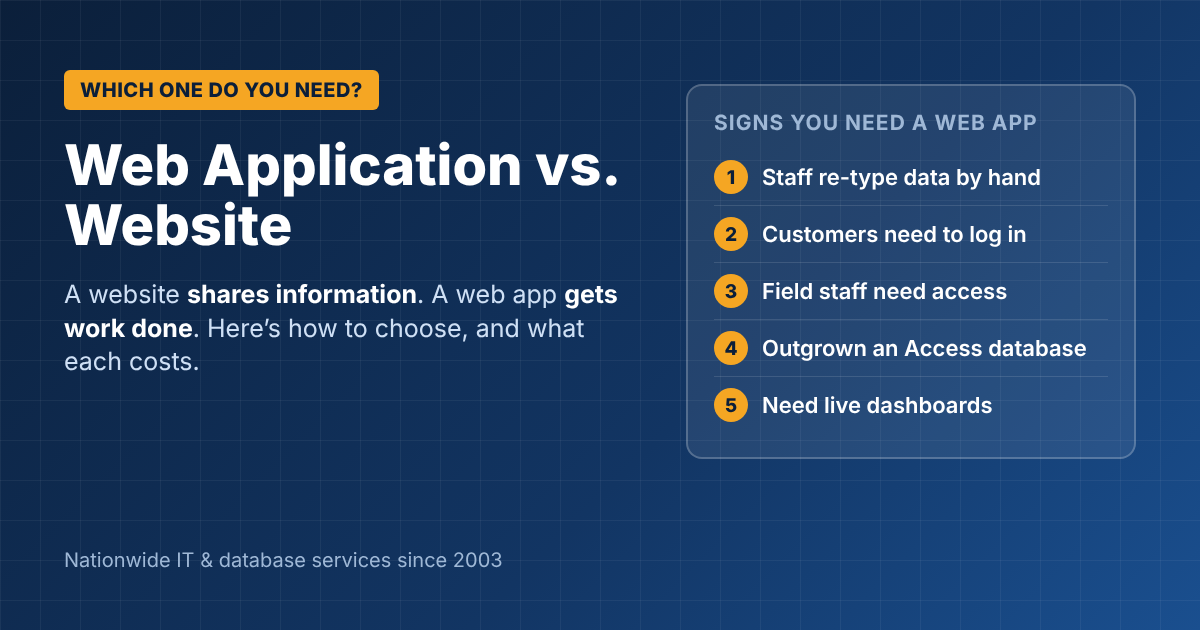
Web Application vs. Website: Which Does Your Business Need?
Web application vs website: which one should your business build? Choosing the wrong one means either paying for features you don’t need, or ending up with a website that can’t do the work your business actually needs. Here’s how to tell them apart, what each costs, and how to decide.
The simple difference
- A website shares information. Visitors read about your services, find your phone number, read your blog and fill in a contact form. Most of the content is the same for everyone.
- A web application lets people do things. Users log in, enter data, place orders, schedule appointments, track jobs or run reports. What each person sees depends on who they are and what they’ve entered.
A quick test: if your users need to log in and get work done, you’re probably looking at a web application.
Web application vs website: side-by-side comparison
| Website | Web application | |
|---|---|---|
| Main purpose | Inform and generate leads | Run a business process |
| Typical users | Prospects and the public | Customers, staff and partners who log in |
| Examples | Company site, blog, landing pages | Customer portal, ordering system, scheduling, dashboards |
| Built with | WordPress or a similar CMS | Custom code plus a database such as SQL Server |
| Data | Mostly static content | Stores and processes data for each user |
| Typical timeline | Weeks | Months |
| Ongoing needs | Updates, security patches, content | Support, hosting, security, new features |
When a website is enough
A website is the right choice when your goal is to be found on Google, explain your services and generate inquiries. A well-built WordPress site with good content, fast hosting and solid SEO does this job well, and it costs far less than custom software.
When you need web application development
You likely need a web application when:
- Staff are copying data between spreadsheets, emails and systems by hand
- Customers call or email for information they could look up themselves, such as order status or appointments
- You need a portal where clients, vendors or field staff log in
- Your current system is an aging Access database or desktop app that only works in the office
- You need dashboards and reports built from live business data
These are signs that a web application could save real time every week.
What web application development costs
Costs vary widely with scope, integrations and users. A focused first version of a business web application often starts in the tens of thousands of dollars, while larger platforms can run to six figures. Our guide to custom software development cost breaks down typical ranges and what drives them.
Websites are far cheaper to build, but don’t forget ongoing costs for both: hosting, security updates and support.
The middle ground: a website with web app features
Many businesses don’t need to choose. A WordPress website can link to a separate customer portal or ordering app on a subdomain, such as portal.yourcompany.com. Visitors get a fast, search-friendly website, and customers get a secure application built for the work they need to do.
Get help choosing
ITsoft builds both: search-friendly business websites and custom web applications backed by SQL Server, for businesses across the U.S. since 2003. Tell us what you’re trying to do, and we’ll give you an honest answer on web application vs website for your business.
Talk to ITsoft about your project
FAQs
Is a web app more expensive than a website?
Usually, yes. A web application needs custom logic, a database, user accounts and more testing. A website mostly needs design and content.
Can WordPress be used to build a web application?
For simple features, such as forms, memberships and basic booking, WordPress plugins can work. For business processes with complex data, permissions or integrations, a custom web application is more reliable and secure.
How long does web application development take?
A focused first version often takes 2–4 months. Larger systems are usually built in phases over several months.
Related reading: Software & web development services · Website programming · How to evaluate a custom software development company · Legacy application modernization